
Every student deserves the opportunity to succeed, regardless of their financial circumstances, background, or access to educational resources.
Imagine being a student who arrives on the first day of class, ready to learn, only to discover that completing an assignment requires purchasing a textbook, accessing a digital platform, or locating an access code you didn't know was available.
For many students, these seemingly small barriers can become significant obstacles to academic participation and success.
As higher education increasingly embraces digital learning, collaborative assessment, and educational technology, institutions must consider not only how these tools enhance learning but also how accessible they are to every student.
The hidden barriers to student success
The cost of educational resources remains a significant barrier to inclusivity in higher education.
A 2026 report by the Student Public Interest Research Groups (Student PIRGs), based on a survey of more than 4,000 students across 107 U.S. institutions, revealed that:
- 70% of surveyed students had skipped purchasing a textbook or access code because of cost.
- 75% had taken a course requiring the purchase of an access code to complete coursework.
- 81% of students who skipped purchasing required materials were concerned about the potential impact on their grades.
- 32.5% reported that course material costs negatively affected their daily lives.
One anonymous undergraduate student surveyed in the report described their experience:
“While I have never skipped buying an access code, it’s not because it was easy to afford, but rather out of fear of failing the course.”
— Undergraduate student, Student PIRGs report (Xie, 2026)
These findings highlight an important distinction: having access to higher education does not necessarily mean having equitable access to learning.
What Does Recent Research Say About Equitable Access?
Recent studies highlight the importance of affordable educational resources in supporting student success.
- Supporting first-generation students: First-generation college students were significantly more likely to earn an A in courses using open educational resources (OER) instead of commercial textbooks (LeMire, 2026).
- Improving student retention: A 2026 AAC&U report examining nearly 700,000 student records across 15 institutions associated OER implementation with lower withdrawal rates and improved academic outcomes in certain contexts (Watson et al., 2026).
- Reducing costs without compromising learning: A University of Central Florida study found no significant differences in grades or drop, fail, and withdrawal rates following OER adoption in general education courses (Mullens, 2026).
While these studies focus on open educational resources rather than Inclusive Access programs, they reinforce the importance of reducing financial barriers to education without compromising learning opportunities.
What Are Inclusive Access and Equitable Access Programs?
Many colleges and universities offer course material affordability programs to help students access required educational resources..
Inclusive Access (IA) typically provides required digital course materials through course-specific fees.
Equitable Access (EA) generally operates at an institutional level, providing required course materials through a standardized semester or credit-hour fee.
These programs may also be known as:
- First Day Access or Day 1 Access
- AutoAccess or All In Access
- Follett Access or My Materials
- Institution-specific bookstore bundles
Unlike OER, these programs are not necessarily free. Their affordability depends on institutional pricing, available alternatives, and participation policies.
Transparent pricing, clear opt-out procedures, and straightforward access instructions are essential to ensuring these programs effectively support students.
Why Equitable Access Matters in Peer Assessment
Peer assessment enables students to develop critical thinking, engage with diverse perspectives, and improve their work through constructive feedback.
However, when students experience difficulties accessing an assessment platform, they may miss opportunities to participate, while their classmates may receive fewer opportunities for meaningful peer feedback.
For students whose subscriptions are already covered through an institutional affordability program, clear access instructions can prevent unnecessary payments, confusion, and delays.
A student's ability to participate in an assessment should reflect their learning and engagement, not their ability to navigate a complicated access process.
How Kritik supports Inclusive Access and Equitable Access programs
At Kritik, we believe that meaningful learning begins with meaningful access.
Students whose Kritik subscriptions are covered through participating Inclusive Access or Equitable Access programs can activate their subscriptions without paying an additional fee at checkout.
However, because institutions use different bookstore providers and delivery methods, locating and redeeming these codes can sometimes be confusing.
To help students navigate this process, Kritik has introduced a dedicated Help Center resource:
Redeeming Access Codes for Inclusive Access & Equitable Access Programs
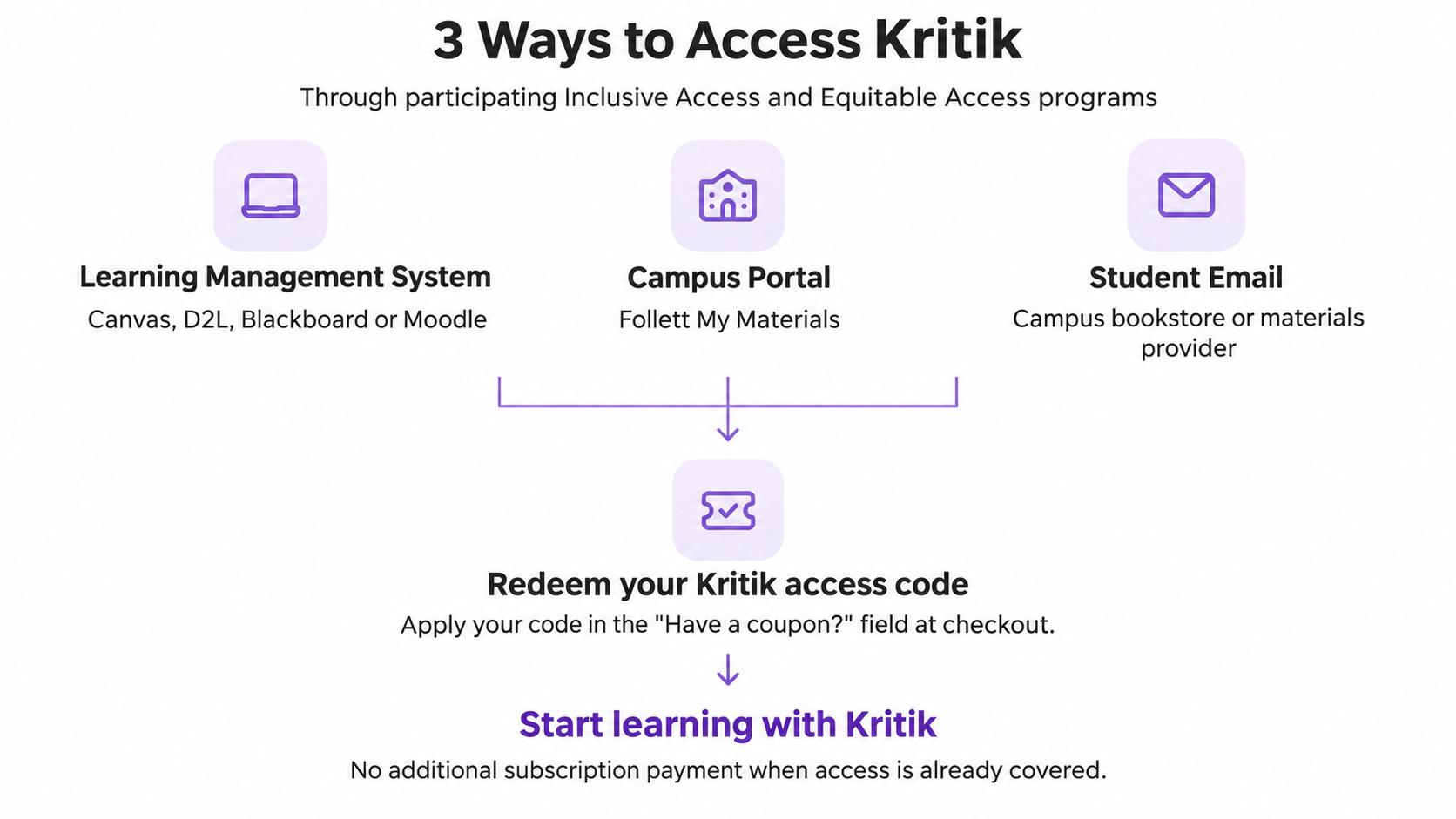
Depending on their institution and bookstore provider, students can retrieve their Kritik access codes through three methods:
- Learning Management System (LMS): Locate Kritik within the digital course materials section in Canvas, D2L Brightspace, Blackboard, or Moodle.
- Campus portal: Retrieve an access code through Follett My Materials, formerly Follett Discover.
- Student email: Locate access codes distributed directly by the campus bookstore or digital course materials provider.
Students can then apply their access code in the "Have a coupon?" field at Kritik checkout to waive the subscription fee.
At select partner institutions, students may also receive automatic access when joining Kritik through their LMS, without needing an access code.
The guide includes detailed instructions and troubleshooting support for missing, delayed, or invalid access codes.
Learn how to find and redeem your Kritik access code.
Five ways educators can create a more inclusive learning environment
Educators can help remove barriers to student participation through small, intentional changes:
1. Communicate course material costs early
Clearly outline required resources, associated fees, and available affordability programs.
2. Prioritize affordable educational resources
Explore open educational resources, library-supported materials, and affordable digital learning tools that align with your course objectives.
3. Share access instructions
Include relevant Help Center resources in your syllabus, LMS, or course announcements.
4. Provide flexibility and accessible learning opportunities
Recognize that students may face different financial, technological, accessibility, and personal circumstances. Where possible, offer reasonable flexibility when students encounter access difficulties.
5. Design assessments that value diverse student perspectives
Incorporate peer assessment, collaborative learning, and multiple opportunities for students to demonstrate their understanding.
Research on equity, diversity, and inclusion in open education emphasizes the importance of addressing the diverse needs of learners rather than assuming that resource availability alone creates inclusivity (Iniesto & Bossu, 2023).
Moving toward a more equitable future in higher education
Inclusivity is not achieved through a single technology, policy, or affordability program. It requires an ongoing commitment to understanding students' experiences and removing unnecessary barriers to learning.
From reducing the financial burden of course materials to simplifying access to digital assessment platforms, every improvement can contribute to a more supportive educational experience.
At Kritik, we are committed to helping educators create learning environments where students can actively participate, develop critical thinking skills, engage in meaningful peer feedback, and take ownership of their learning.
Because every student deserves the opportunity to learn, contribute, and succeed.
Does your institution offer Inclusive Access or Equitable Access?
Share our step-by-step student guide to help your students get started with Kritik.
What does the latest research tell us about equitable access?
Recent research continues to demonstrate the importance of reducing barriers to educational resources.
Supporting first-generation college students
A 2026 study published in Open Praxis examined student academic performance across 20 undergraduate courses at a large public research university in the United States.
The study found that first-generation college students were significantly more likely to earn an A in courses where instructors used open educational resources (OER) instead of commercial textbooks (LeMire, 2026).
These findings suggest that reducing financial barriers may be particularly beneficial for students who have historically faced additional challenges in higher education.
Improving student success and retention
In 2026, the American Association of Colleges and Universities (AAC&U) published a comprehensive report examining nearly 700,000 student records across 15 institutions, alongside responses from more than 200 instructors.
The research identified several potential benefits associated with OER implementation, including:
- Lower course withdrawal rates.
- Improvements in the proportion of students earning A grades.
- Shorter time to degree completion for certain student populations.
- Greater opportunities to rethink teaching and learning practices.
The report identified thoughtfully implemented OER as a new high-impact practice in higher education (Watson et al., 2026).
Reducing costs without compromising learning
Not every study finds that reducing course material costs directly improves academic performance.
A 2026 doctoral dissertation from the University of Central Florida found no significant impact of OER adoption on final course grades or drop, fail, and withdrawal rates in general education courses (Mullens, 2026).
However, reducing financial barriers remains valuable even when academic outcomes remain unchanged.
Students should not have to pay more than necessary to achieve the same educational outcomes.
Together, these studies reinforce the importance of affordability while recognizing that meaningful inclusivity requires more than simply providing access to educational materials.
Understanding Inclusive Access and Equitable Access programs
Many higher education institutions have introduced course material affordability programs to help students obtain required learning resources.
Two common approaches are Inclusive Access (IA) and Equitable Access (EA).
Inclusive Access typically provides students enrolled in participating courses with required digital learning materials through course-related charges.
Equitable Access generally operates at a broader institutional level, providing students with required materials through a standardized semester or credit-hour fee.
Depending on the institution, these programs may also be known as:
- First Day Access
- Day One Access
- AutoAccess
- Follett Access
- All In Access
- Institution-specific bookstore bundles
Unlike open educational resources, IA and EA programs are not necessarily free. Their affordability depends on institutional agreements, pricing structures, and the alternatives available to students.
While these programs aim to improve access to required course materials, institutions must also prioritize transparent pricing, informed student choice, clear opt-out procedures, and straightforward access instructions..
A multi-institutional study involving 13 community colleges found no statistically significant differences in academic outcomes following the introduction of an Inclusive Access pilot program (Spica, 2023).
This reinforces the importance of evaluating these programs based on their actual affordability, convenience, and ability to reduce barriers, rather than assuming that access alone guarantees improved academic performance.
Why equitable access matters in peer assessment
Equitable access becomes particularly important when learning activities depend on student collaboration.
In peer assessment, students learn by creating work, evaluating their peers, receiving feedback, and reflecting on their performance.
When a student cannot access an assessment platform, the consequences can extend beyond their individual experience. Their peers may also miss opportunities to receive feedback, engage with different perspectives, and learn collaboratively.
Consider a student who has already paid for their course materials through their institution's bookstore program but encounters a payment screen when joining an assessment platform.
Without clear instructions, that student may mistakenly believe they need to pay again, delay completing their assignment, or miss an opportunity to participate in peer learning.
This is why educational technology providers, instructors, and institutions must work together to address not only financial barriers but also the administrative and technological obstacles that students encounter.
A student's ability to participate in an assessment should reflect their learning and engagement, not their ability to navigate a complicated access process.
How Kritik supports Inclusive Access and Equitable Access programs
At Kritik, we believe that meaningful learning begins with meaningful access.
Students whose institutions provide Kritik through participating Inclusive Access or Equitable Access programs may receive an access code through their campus bookstore, learning management system (LMS), or institutional email.
However, because institutions use different bookstore providers and delivery methods, locating and redeeming these codes can sometimes be confusing.
To help students navigate this process, Kritik has introduced a dedicated Help Center resource:
Redeeming Access Codes for Inclusive Access & Equitable Access Programs
The guide helps students understand:
- How to identify their institution's IA or EA program.
- Where to locate their Kritik access code within their LMS.
- How to retrieve access codes through their campus portal or student email.
- How to redeem an access code in Kritik without paying a second subscription fee when their access is already covered.
- What to do if an access code is missing, delayed, or invalid.
- Where to seek assistance when experiencing difficulties.
At select partner institutions, students may also receive automatic access when joining Kritik through their LMS, without needing to redeem a code manually.
Instructors can share this resource directly with their students, include it in their course syllabus, or publish it within their LMS to help students get started.
View Kritik's Inclusive Access & Equitable Access Student Guide
Five ways educators can create a more inclusive learning environment
Building a more inclusive classroom does not always require significant changes to the curriculum. Small, intentional adjustments can make a meaningful difference.
1. Communicate course material costs early
Clearly communicate required textbooks, digital platforms, associated costs, and available access programs before students begin completing assignments.
2. Prioritize affordable educational resources
Explore open educational resources, library-supported materials, and affordable digital learning tools that align with your course objectives.
3. Make access instructions easy to find
Include step-by-step instructions and relevant support resources within your syllabus, LMS, or course announcements.
4. Provide flexibility and accessible learning opportunities
Recognize that students may face different financial, technological, accessibility, and personal circumstances. Where possible, offer reasonable flexibility when students encounter access difficulties.
5. Design assessments that value diverse student perspectives
Incorporate collaborative learning, peer assessment, authentic assignments, and multiple ways for students to demonstrate their understanding.
Research on equity, diversity, and inclusion in open education highlights the importance of considering how educational practices address the needs of diverse learners, rather than assuming that making resources available automatically creates an inclusive experience (Iniesto & Bossu, 2023).
Moving toward a more equitable future in higher education
Inclusivity is not achieved through a single technology, policy, or affordability program. It requires an ongoing commitment to understanding students' experiences and removing unnecessary barriers to learning.
From reducing the financial burden of course materials to simplifying access to digital assessment platforms, every improvement can contribute to a more supportive educational experience.
At Kritik, we are committed to helping educators create learning environments where students can actively participate, develop critical thinking skills, engage in meaningful peer feedback, and take ownership of their learning.
Because every student deserves the opportunity to learn, contribute, and succeed.
Does your institution offer Inclusive Access or Equitable Access? Share our step-by-step student guide to help your students get started with Kritik.
Iniesto, F., & Bossu, C. (2023). Equity, diversity, and inclusion in open education: A systematic literature review. Distance Education, 44(4), 694–711. https://doi.org/10.1080/01587919.2023.2267472
LeMire, S. (2026). Impact of OER on first generation college students: A case study. Open Praxis, 18(1), 132–145. https://doi.org/10.55982/openpraxis.18.1.926
Mullens, A. (2026). An investigation into the impact of open educational resources (OER) on postsecondary student outcomes [Doctoral dissertation, University of Central Florida]. STARS. https://stars.library.ucf.edu/gradstudies_etd_2026/136/
Spica, E. (2023). Inclusive access: A multi-institutional study of academic outcomes from a statewide community college automatic billing eTextbook pilot. Community College Journal of Research and Practice, 47(3), 197–216. https://doi.org/10.1080/10668926.2021.1990161
Watson, C. E., Miceli, H., Perkins, B. A., Chittum, J. R., & Schneider, H. (2026). Open educational resources: A new high-impact practice. American Association of Colleges and Universities. https://files.eric.ed.gov/fulltext/ED681497.pdf
Xie, D. (2026). Fixing the broken textbooks market (4th ed.). Student Public Interest Research Groups. https://studentpirgs.org/assets/uploads/2026/02/Fixing-the-Broken-Textbooks-Market-Fourth-Edition.pdf
