

Every student deserves the opportunity to succeed, regardless of their financial circumstances, background, or access to educational resources.
Writing has long been a fundamental component of higher education. It encourages students to organize their thoughts, evaluate evidence, communicate arguments, apply course concepts, and develop critical thinking skills.
However, as generative AI becomes increasingly integrated into students' academic experiences, instructors face a growing challenge: determining whether a polished submission reflects genuine understanding or simply the ability to generate a convincing response.
For instructors teaching large classes, this challenge becomes even more complex. How can educators provide meaningful, personalized feedback, encourage authentic writing, and gain greater visibility into student learning without significantly increasing their grading workload?
The answer may lie in rethinking assessment itself.
Moving from traditional assessment to authentic assessment
Traditional assessment often emphasizes the final product, whether it is an essay, research paper, examination, or written reflection.
Authentic assessment, by contrast, emphasizes students' ability to apply knowledge and skills in meaningful, real-world contexts.
As explored by Kritik Co-founder Carine Marette and Matthew Landreth in their 2025 academic work at Indiana University, Rethinking Assessment: Systematic Review on Authentic Assessments and AI-Enhanced Authentic Assessment in Emerging Learning Technologies:
“Authentic assessment fosters real-world application, critical thinking, and personalized learning.”
— Undergraduate student, Student PIRGs report (Xie, 2026)
Rather than simply asking students to demonstrate what they know, authentic assessment encourages them to demonstrate how they think, make decisions, solve problems, and apply their understanding in different contexts.
In writing assignments, this could involve asking students to:
- Analyze a real-world problem using course concepts.
- Develop and justify an evidence-based argument.
- Evaluate alternative perspectives and competing explanations.
- Provide constructive feedback on their peers' work.
- Revise their writing and explain the reasoning behind their changes.
These approaches shift assessment away from evaluating a single submission and toward understanding the learning process behind it.
The five dimensions of authentic assessment
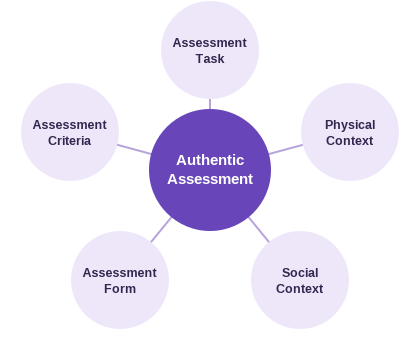
Gulikers, Bastiaens, and Kirschner (2004) introduced a five-dimensional framework for designing authentic assessments that reflect the demands of professional practice.
- Assessment Task: Ask students to apply knowledge to meaningful problems rather than simply recall information.
- Physical Context: Incorporate real datasets, research publications, professional tools, and authentic case studies.
- Social Context: Encourage peer review, collaborative problem-solving, and constructive discussion.
- Assessment Form: Use reports, proposals, presentations, and other outputs that reflect real-world applications.
- Assessment Criteria: Evaluate the quality of evidence, depth of reasoning, application of knowledge, and justification of decisions.
Together, these dimensions help educators design assessments that prioritize meaningful learning over the completion of a task.
Why Feedback Should Be Part of Learning, Not Just the Final Grade
Students often receive feedback after completing an assignment, when there may be little opportunity to apply it.
Meaningful feedback should instead develop student feedback literacy: the ability to understand, interpret, evaluate, and act on feedback.
A study by Hoo, Deneen, and Boud (2022) examined 237 reflective journals from 79 undergraduate students participating in self and peer assessment activities, exploring how structured interventions can develop students' feedback capabilities.
Through structured peer assessment, students can:
- Examine how their peers approach the same assignment.
- Develop evaluative judgment by applying assessment criteria.
- Identify strengths and weaknesses in different arguments.
- Reflect on their understanding and apply feedback to future work.
When students become active participants in assessment, feedback becomes a learning activity rather than simply a justification for a grade.
Can AI Support Authentic Writing Without Replacing Student Thinking?
AI-powered tools can provide immediate feedback and personalized guidance. However, receiving assistance does not necessarily mean students are developing the ability to perform independently.
A 2024 study published in Computers & Education examined the impact of AI assistance on student agency through a randomized experiment involving:
- 1,625 students
- 10 courses across different disciplines
- 8 weeks of peer review activities
The researchers found that students tended to rely on AI assistance rather than consistently transferring the skills supported by that assistance into independent practice (Darvishi et al., 2024).
This raises an important question:
Are students using AI to strengthen their thinking, or are they becoming dependent on AI to think for them?
Research by Escalante, Pack, and Barrett (2023) also found no statistically significant difference in writing outcomes between students receiving AI-generated feedback and those receiving human tutor feedback in a six-week study involving 48 university students learning English as a new language.
These findings suggest that AI can play a supporting role, but its educational value depends on how it is integrated into assessment.
The objective should be to establish clear expectations that preserve student agency, independent reasoning, and ownership of the learning process.
Making Authentic Writing More Visible
Consider two students submitting equally polished essays.
One develops an argument, examines supporting evidence, receives feedback, and revises their work. Another generates an essay using AI and submits it with minimal engagement.
Although their final submissions may appear similar, the learning experiences behind them are fundamentally different.
Process-based assessment encourages educators to consider how students develop ideas, evaluate information, respond to feedback, revise their arguments, and use AI where permitted.
Making these activities more visible moves the conversation beyond AI detection and toward authorship transparency, meaningful assessment, and responsible AI use.
How Can Instructors Scale Authentic Assessment in Large Classes?
Providing individualized feedback and reviewing multiple drafts across hundreds of students can create significant demands on instructors.
However, scaling authentic assessment does not necessarily require creating more assignments or spending more time grading. Educators can restructure existing assignments so students take a more active role in the feedback process.
Redesigning a Traditional Writing Assignment
Traditional approach: Students write an essay, submit it, and receive a grade and instructor feedback.
Authentic, process-based approach:
- Create: Students develop an evidence-based argument addressing a meaningful disciplinary problem.
- Evaluate: Students review their peers' work using a structured rubric focused on reasoning and application of knowledge.
- Reflect: Students examine the feedback they receive and identify opportunities for improvement.
- Revise: Students improve their work and explain which changes they made and why.
This approach creates multiple opportunities for learning within a single assignment, while distributing formative feedback across students and allowing instructors to retain oversight.
Bringing Authentic Assessment and Authorship Transparency Together with Kritik
At Kritik, we believe that assessment should be an opportunity for learning, rather than simply a measurement of learning.
Kritik360 supports structured, rubric-based peer assessment, helping students develop critical thinking and evaluative judgment through meaningful peer feedback.
VisibleAI provides greater visibility into the writing process, including writing and revision history, pasted content, and AI-assisted writing activity within the editor.
Together, these tools help educators create opportunities for personalized feedback, establish clearer expectations around AI use, and encourage student ownership of writing while managing assessment across larger classes.
Rather than focusing exclusively on the final submission, educators can gain additional context about the learning process behind it.
Continue the Conversation: Rethinking Assessment at Scale
How can these research-informed strategies be applied in real university classrooms?
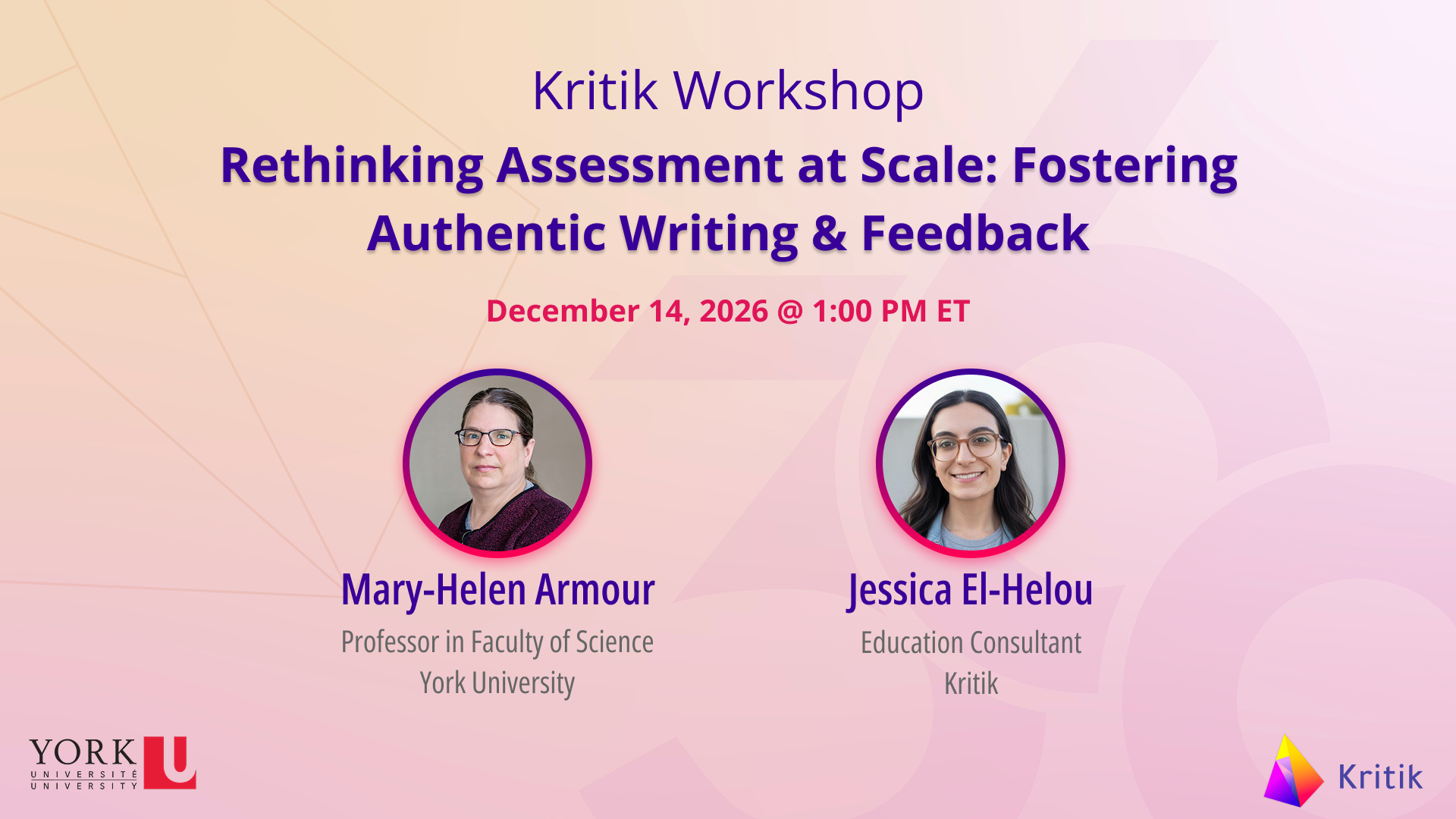
Join Mary-Helen Armour, Professor in the Faculty of Science at York University, and Jessica El-Helou, Education Consultant at Kritik, for a practical discussion on authentic writing, meaningful feedback, and scalable assessment.
Rethinking Assessment at Scale: Fostering Authentic Writing & Feedback
📅 Monday, December 14, 2026
🕐 1:00 PM ET
💻 Live on Zoom
Discover how to design meaningful writing assignments, strengthen critical thinking through peer assessment, and gain greater visibility into student learning without placing an unsustainable grading burden on instructors.
Register for the December 14 workshop
Darvishi, A., Khosravi, H., Sadiq, S., Gašević, D., & Siemens, G. (2024). Impact of AI assistance on student agency. Computers & Education, 210, Article 104967. https://doi.org/10.1016/j.compedu.2023.104967
Escalante, J., Pack, A., & Barrett, A. (2023). AI-generated feedback on writing: Insights into efficacy and ENL student preference. International Journal of Educational Technology in Higher Education, 20, Article 57. https://doi.org/10.1186/s41239-023-00425-2
Gulikers, J. T. M., Bastiaens, T. J., & Kirschner, P. A. (2004). A five-dimensional framework for authentic assessment. Educational Technology Research and Development, 52(3), 67–86. https://doi.org/10.1007/BF02504676
Hoo, H.-T., Deneen, C., & Boud, D. (2022). Developing student feedback literacy through self and peer assessment interventions. Assessment & Evaluation in Higher Education, 47(3), 444–457. https://doi.org/10.1080/02602938.2021.1925871
Marette, C., & Landreth, M. (2025). Rethinking assessment: Systematic review on authentic assessments and AI-enhanced authentic assessment in emerging learning technologies [Unpublished course manuscript]. Department of Education, Indiana University.
