
Prof. Francine Guice, Faculty Lead for Educational AI in the Department of Accounting, Finance, Economics, and Law at Oakland University, integrates peer assessment and responsible AI practices into her business and law courses to prepare students for an evolving workplace. Peer assessment is a structured process in which students evaluate each other’s work using instructor-designed rubrics to build critical thinking, evaluative judgment, and feedback skills while reducing instructor grading time. By combining Kritik360 and VisibleAI, she helps students strengthen critical thinking, professional judgment, and feedback skills while learning how to use AI responsibly and transparently.
"Responsible AI is what I try to teach—not just by talking about it, but by utilizing the products."– Prof. Francine Guice
In this story, higher education faculty, instructional designers, and institutions will see how Prof. Guice designs assignments that build professional readiness, develops students’ evaluative judgment through structured peer assessment, aligns assessment with evolving AI literacy expectations, and integrates responsible AI use into her courses with Kritik360, VisibleAI, and LMS-connected workflows. As online learning enrollment increased by 29% in higher education, these peer-assessment and AI-literacy workflows are equally relevant in digital course delivery, collaborative learning, and technology-enabled learning environments where educational technology shapes the student learning experience and building trust in AI systems matters.
Download the deck and the full recording of Prof. Francine Guice's workshop.
Preparing Future-Ready Business Professionals Through Responsible AI and Peer Assessment
Artificial intelligence is changing how business professionals work, communicate, and make decisions. Rather than trying to eliminate AI from the classroom, Prof. Guice believes educators should teach students how to use it responsibly while continuing to develop the judgment, communication skills, and critical thinking employers expect. That makes peer assessment and transparent AI use especially relevant for institutions evaluating new technologies, responsible development practices, and trustworthy AI approaches in modern teaching.
"Unfortunately, it's not going away."
Her courses are built around authentic business and law assignments that push students to think critically, evaluate information, collaborate with peers, and reflect on their decision-making throughout the learning process. Peer assessment also helps students better understand the assessment criteria they are being asked to meet. Rather than treating AI as a replacement for learning, she teaches students to use it as a tool that supports, rather than replaces, independent thinking.
Example Assignment and Assessment Design with Peer Feedback
Throughout her courses, Prof. Guice combines structured peer assessment with transparent AI use to help students develop both disciplinary knowledge and professional skills.
Students begin in the Create stage by completing authentic business or law assignments while following the course's AI policy. They are encouraged to use AI responsibly to help generate ideas, organization, or research where appropriate, while maintaining ownership of their thinking and supporting independent learning.
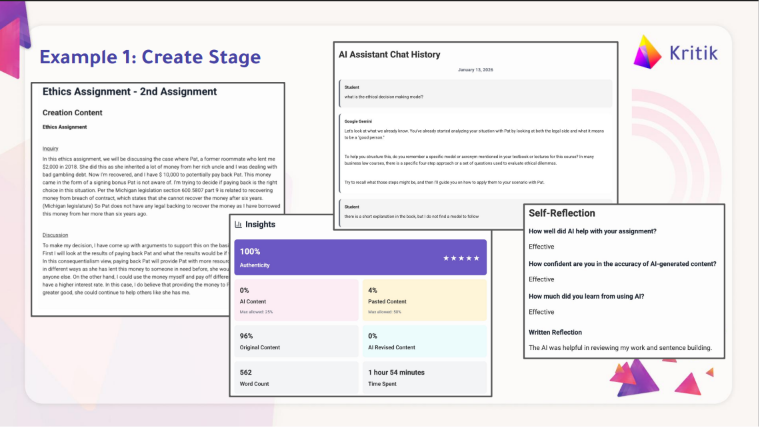
In digital learning environments, LMS-connected educational technology can support asynchronous learning through online collaboration tools, while also letting educators post announcements, grade assignments, and track attendance and student progress.
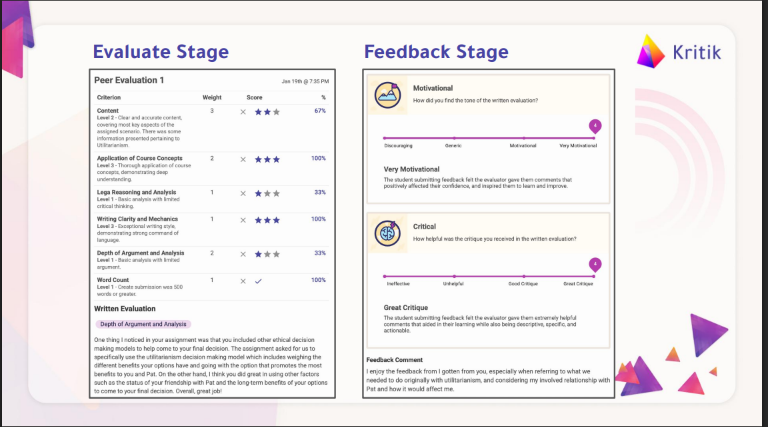
During the Evaluate stage, participating students anonymously review multiple peer submissions from peers at the same level, which helps surface different perspectives and strengthen the cognitive processes involved in judgment and problem solving. Rather than simply assigning scores, they provide constructive written feedback that explains their reasoning and recommends areas for improvement.
Peer review can be used in synchronous learning when all participants are online in real time, or adapted for asynchronous learning when students complete reviews on their own schedule.
Finally, students complete the Feedback stage by reflecting on the evaluations they received and rating the quality of the feedback provided by their peers, a step that encourages active participation, supports knowledge sharing, and keeps them actively engaged in the feedback process to promote learning. This closes Kritik360's 360-degree feedback loop while helping students strengthen both their own work and their ability to communicate professionally.
LMS-connected workflows can also support instant feedback in some course setups, while computer-based training supports self-paced review and revision.
Build Future-Ready Business Professionals with Kritik360 & VisibleAI for Responsible AI
Prof. Francine Guice has successfully integrated Kritik360 and VisibleAI into her business and law courses as educational technology that supports collaborative learning and prepares students for varied modern learning environments. Through structured peer assessment, transparent AI use, and authentic learning experiences, her students strengthen their critical thinking, professional communication, and writing skills while contributing more effectively to group projects. By focusing on the learning process, not just the final submission, she has created a classroom where students develop the workplace skills they'll carry into their future careers. These methods can support faculty members and educational technologists as they design courses that require students to engage with academic standards in technology-rich settings.
Start preparing your students for the future of work by creating your course on Kritik today.