
.jpg)
Dr. Andrew Darnel, Assistant Professor in the Faculty of Health Sciences at the University of Ottawa, uses peer assessment, case-based learning, and responsible AI practices to help students develop the critical thinking and clinical decision-making skills required in healthcare. Teaching classes ranging from 25 to 170 students, Dr. Darnel has redesigned assessment to move beyond memorization, using Kritik360 and VisibleAI to create authentic learning experiences that scale across large higher education courses.
Rather than asking students to simply recall information, he challenges them to solve realistic health science problems, evaluate the reasoning of their peers, and reflect on their own decisions throughout the learning process. By combining structured peer review, rubric-based assessment, and AI transparency, he helps students build professional judgment while learning how to use generative AI responsibly.
"I'm trying to encourage responsible use of artificial intelligence."
In this story, we'll explore how Dr. Darnel uses peer assessment, case-based learning, and VisibleAI to strengthen critical thinking, improve student feedback, and redesign assessment for the age of AI.
Download the deck and the full recording of Dr. Andrew Darnel's workshop.
Building Critical Thinking and Problem Solving Through Peer Assessment in Higher Education
Large university classes present a difficult challenge. Instructors want students to engage in deeper learning and receive meaningful feedback, but providing individualized assessment becomes increasingly difficult as class sizes grow.
For Dr. Darnel, the solution isn't simply adding more grading, it is redesigning assessment.
Teaching courses with as many as 170 students, he has replaced assignments that reward memorization with authentic assessment activities that require students to analyze information, solve realistic problems, and justify their decisions. Peer assessment becomes an essential part of that process, giving students multiple opportunities to learn from one another while reducing grading workload for instructors.
Rather than viewing peer review as a shortcut, Dr. Darnel sees it as preparation for professional practice.
"Peer evaluation takes place in every single industry."
Whether graduates enter healthcare, research, government, or industry, they will be expected to review colleagues' work, provide constructive feedback, and make evidence-based decisions. His approach helps students develop these professional skills long before they enter the workplace.
Using Case-Based Learning and Rubric-Based Assessment in Machine Learning Algorithms
Instead of asking students to recall facts from lectures, Dr. Darnel structures his assignments around realistic health science case studies that require students to apply course concepts to practical situations, supporting more personalized learning experiences for students.
One example shared during the workshop is a frostbite case study, where students assess a patient's symptoms, analyze available evidence, and recommend an appropriate treatment plan. Rather than searching for a single correct answer, students must justify their decisions using clinical reasoning and evidence-based practice.
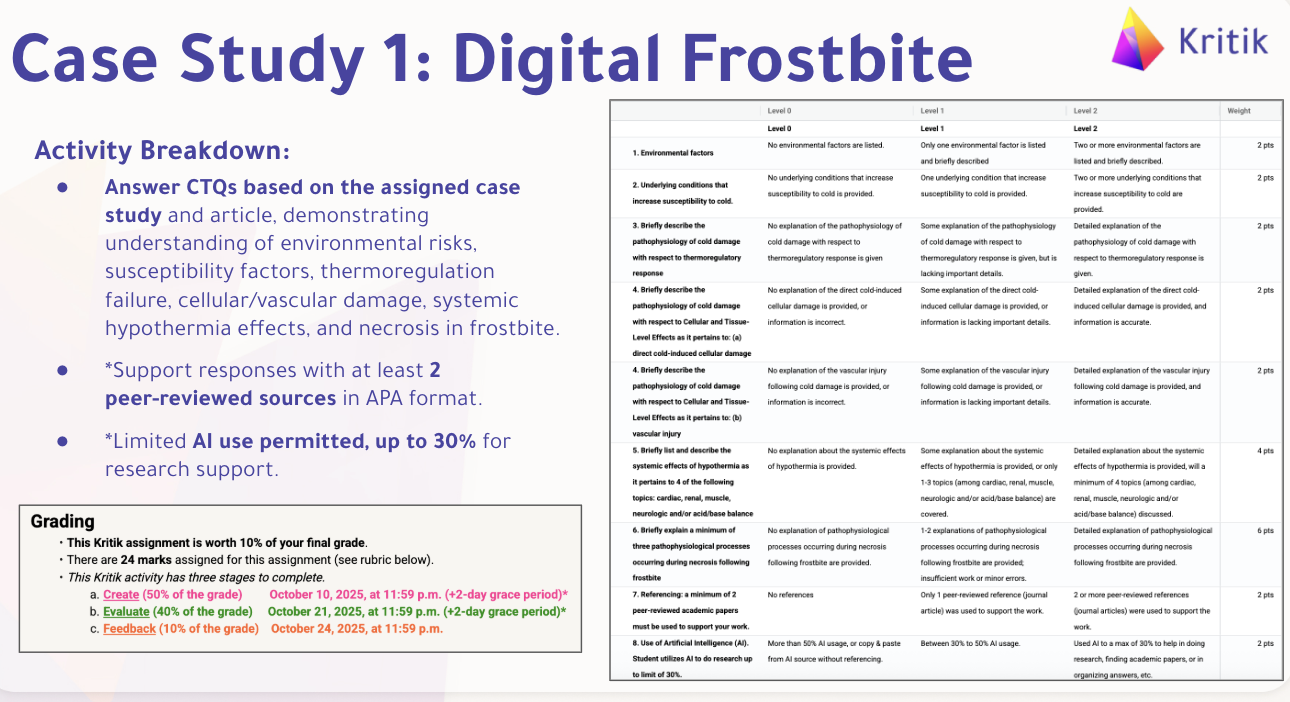
In the Create stage, students complete the case study while following the course's AI guidelines. AI can be used within the instructor's expectations, but students remain responsible for verifying information, evaluating AI-generated content, and supporting their recommendations with evidence. VisibleAI provides transparency into the writing process, allowing instructors to understand how each submission was developed while encouraging responsible AI use. It also helps educators analyze vast amounts of data quickly for educational insights.
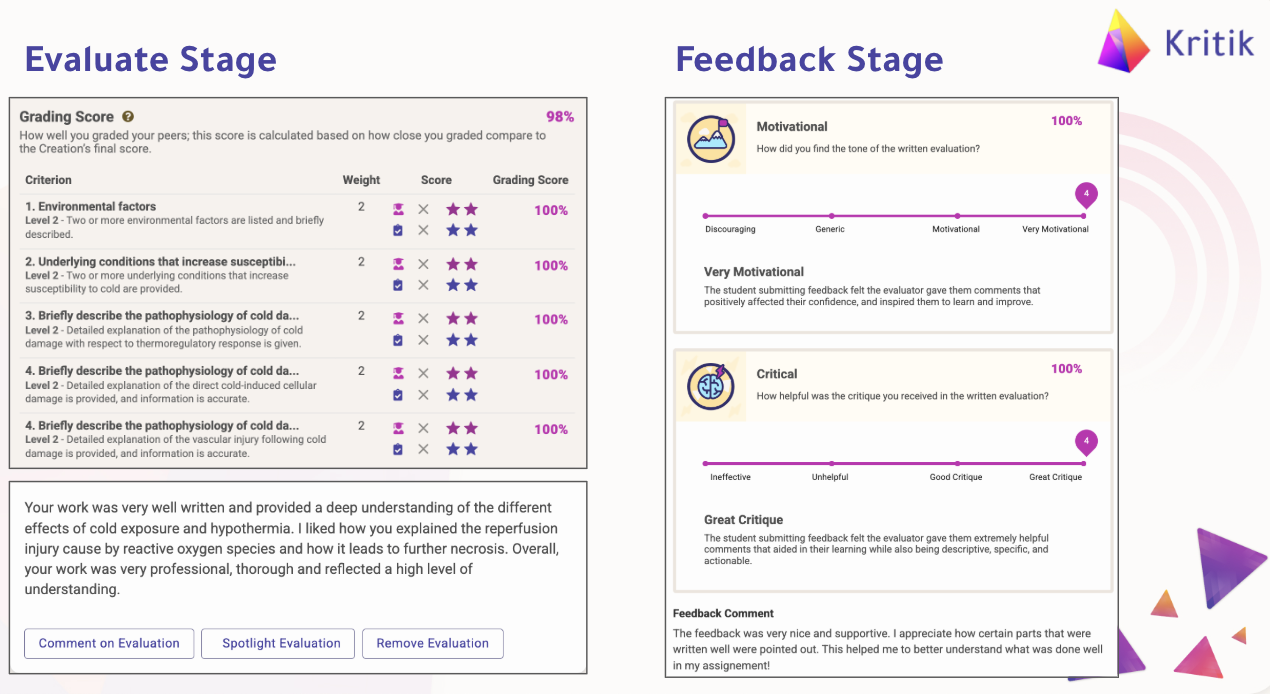
Next, in the Evaluate stage, students anonymously review multiple peer submissions using custom instructor-designed rubrics in Kritik360. AI-driven platforms can also provide real-time feedback to support participation. Dr. Darnel designs each rubric to align with the learning outcomes of the assignment, giving students clear expectations before they begin and a structured framework for evaluating their peers.
His rubric asks students to assess areas such as:
- Application of course concepts
- Clinical reasoning and decision-making
- Use of supporting evidence
- Accuracy and completeness of recommendations
- Clarity and professionalism of written communication
Regular feedback systems improve engagement and retention, and they can improve learning outcomes by 20–30%.
Rather than simply assigning a score, students explain why a response is effective and provide constructive, evidence-based feedback. This process can increase student performance by 12% on average. Reviewing multiple approaches to the same case helps students strengthen their own critical thinking while developing evaluative judgment and a deeper understanding of the course material.
Finally, in the Feedback stage, students reflect on the evaluations they receive and rate the quality of the feedback provided by their peers, completing Kritik360's 360-degree feedback process in a way that can reduce grading time by 50%. This final stage reinforces that learning extends beyond submitting an assignment. Students improve their own work while also developing the communication and feedback skills they will use throughout their professional careers.
AI can also analyze student data to improve engagement strategies.
Rather than simply receiving instructor comments after submitting an assignment, students become active participants in the assessment process, strengthening both their understanding of course content and their ability to evaluate professional work. AI can personalize learning experiences within an LMS for students. Generative AI can automate content creation in LMS. ai agents can interact with LMS for task automation.
Teaching Responsible Artificial Intelligence with VisibleAI
Like many educators, Dr. Darnel recognizes that generative AI is becoming part of students' everyday learning process and of everyday life more broadly.
Instead of attempting to eliminate AI from his courses, he teaches students how to use it responsibly. More broadly, artificial intelligence (AI) includes many educational tools, while generative AI is one category within that larger field. AI tools can automate repetitive tasks so instructors can focus more on student engagement.
"We need to start riding the AI wave." Academic integrity promotes honesty in educational environments.
Using VisibleAI alongside Kritik360, he establishes clear expectations for AI use while giving students the flexibility to incorporate AI appropriately into their assignments. Strong academic integrity policies are associated with improved student performance. Students may use AI within instructor-defined thresholds, but they remain responsible for verifying information, supporting their conclusions with evidence, and demonstrating their own understanding.
He also encourages students to "reverse engineer" AI responses by checking sources, validating information, and identifying inaccuracies rather than accepting AI-generated content at face value. In 2023, 61% of students reported witnessing academic dishonesty. Over 70% of educators believe academic integrity is crucial for learning. This transforms AI from a shortcut into a tool that supports deeper learning, critical evaluation, and AI literacy.
For Dr. Darnel, transparency is more valuable than AI detection.
VisibleAI provides instructors with insight into students' writing process, AI interactions, revision history, and authorship timeline, allowing conversations about academic integrity to focus on learning rather than suspicion. Technology can help enforce academic integrity through plagiarism detection.
"It provides transparency."