
When Professor Robin Potter set out to strengthen critical thinking skills in her asynchronous courses at Seneca Polytechnic, she wanted a way to go beyond final submissions and into how students think. With Kritik360, Robin redesigned her assignments around process-based peer assessment, giving students structured opportunities to analyze, evaluate, and reflect at every step.
Critical Thinking and Higher-Order Learning
Critical thinking is essential for student success in today’s digital and AI-rich learning environments. The importance of having students to analyze information, evaluate evidence, recognize bias, and make reasoned decisions is amplified, especially when content may be AI-generated. These abilities enable deeper engagement with course material and ensure that genuine learning occurs, not just polished outputs.
Collaborative activities such as peer assessment, self-assessment, and structured feedback help students actively practice these skills. Reviewing peer work, applying clear criteria, and reflecting on feedback all push students to justify judgments, consider alternative perspectives, and refine their reasoning. These strategies develop evaluative judgment, metacognition, and communication skills that transfer beyond the classroom.
Why Assess Process Over Product (especially in the age of AI)?
Generative AI in education can blur authorship, but it also opens doors for deeper learning when used transparently. Robin’s approach embraces AI as a co-creator inside a rigorous process: students document prompts and outputs, then make metacognitive judgments about quality, bias, and relevance. By scaffolding tasks, she aligns assignments with Bloom’s Taxonomy.

E-book: 100+ Examples of How to Apply Blooms' Taxonomy
Students move from understanding and applying toward analyzing and evaluating, and higher-order outcomes become more visible and assessable.
This emphasis on process is a natural fit for peer assessment. Within Kritik360’s three stages: Create, Evaluate, and Feedback, students submit work, conduct peer evaluations using a clear rubric, and then close the loop by rating the quality of the motivational and helpful feedback they received. With true 360-degree feedback, this loop builds accountability, feedback literacy, and a paper trail of thinking that’s hard to fake and easy to learn from.
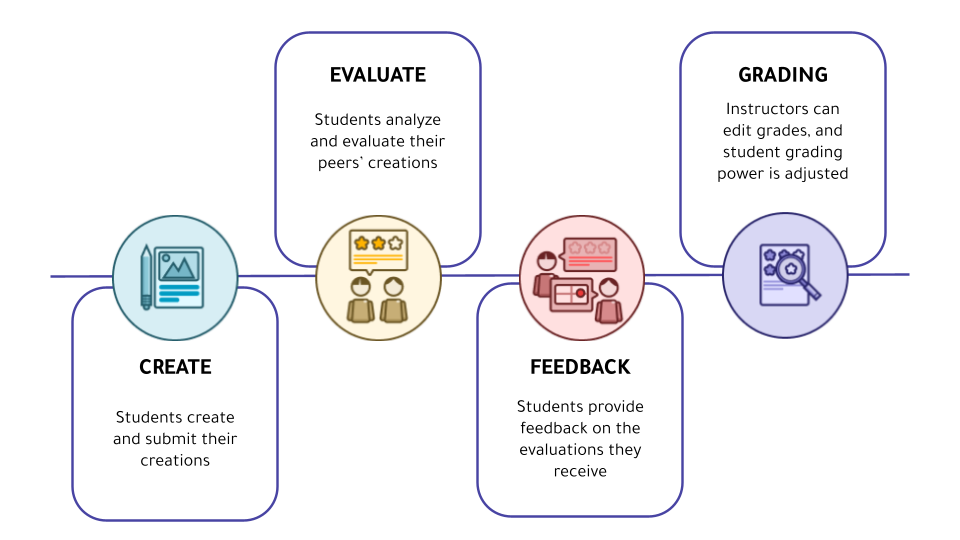
How Robin Structures Kritik360’s 4-Step Peer Assessment Process
“Kritik360 really facilitates that process-oriented structure and… helps [students] apply their critical thinking and interpersonal skills at the same time.” - Prof. Robin Potter, Seneca Polytechnic
Robin structures her Kritik360 activities as a scaffolded process that captures both the final product and evidence of how it was developed. Students document AI use, reflect on their decisions, and anonymously evaluate peers using clear criteria, building evaluative judgment by assessing work against shared standards. Multiple artifacts and peer perspectives help deepen subject understanding while encouraging thoughtful revision. Incorporating a structured framework ensures that peer assessment activities are inclusive and address different engagement styles and learning preferences in a classroom environment.
Robin’s “AI Inclusivity” assignment exemplifies her method:
- Creation: Students craft a task description, develop diverse personas, and use a generative AI tool to draft and adapt messages for each persona. They include the prompts and outputs.
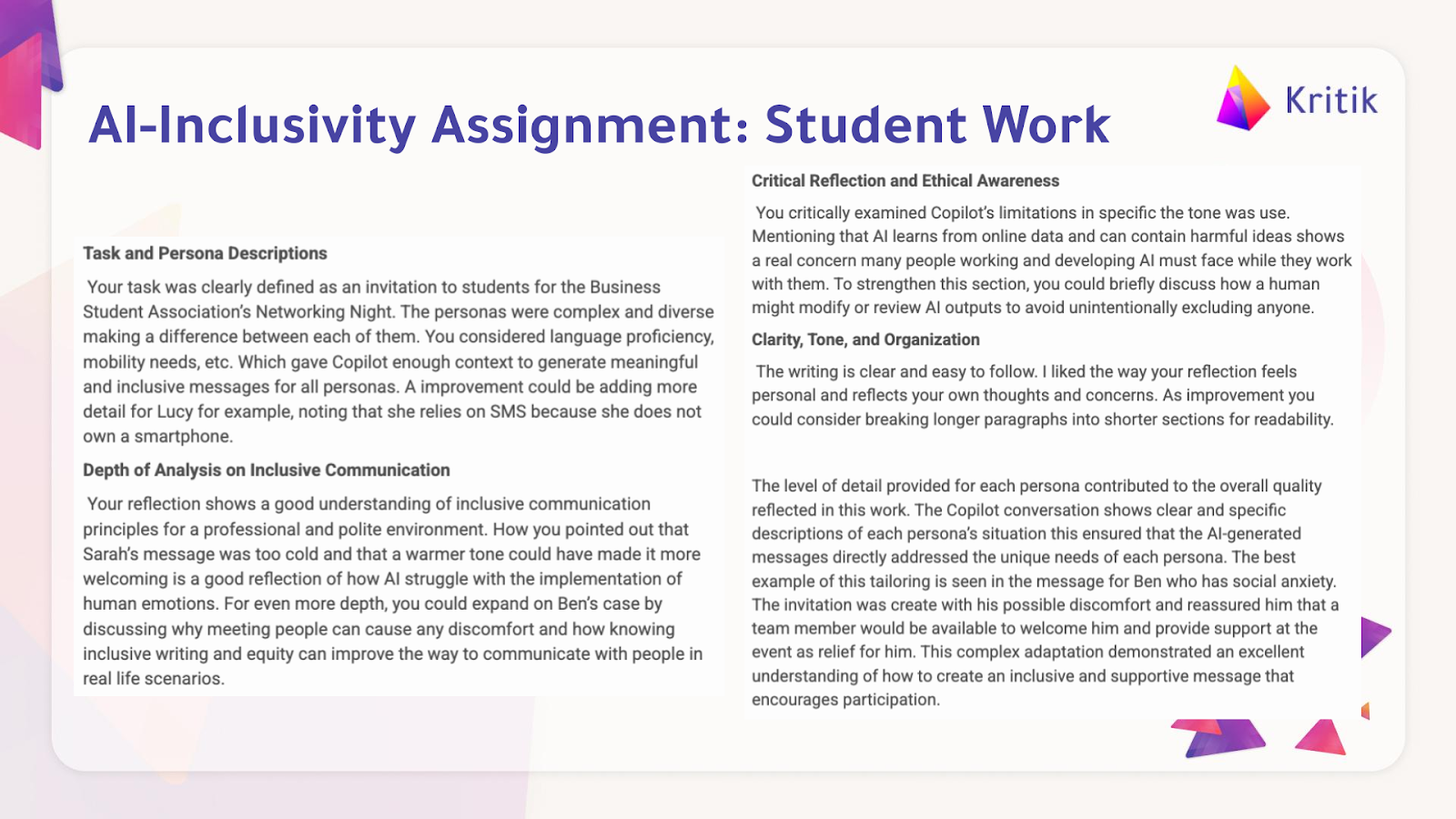
- Evaluation: Peers review the reflection and analysis alongside the AI text, using criteria tied to course concepts and the textbook. The rubrics prompt targeted comments, not vague praise. Students are encouraged to provide advice and explain their reasoning to peers, fostering deeper understanding and peer teaching.
- Feedback: Students rate the helpfulness and motivation of peer comments, rewarding specificity and constructive tone. Through peer assessment, students provide feedback and benefit from a wider variety of perspectives more quickly than relying solely on instructor reviews, helping them develop a stronger sense of understanding and practical application of course material.
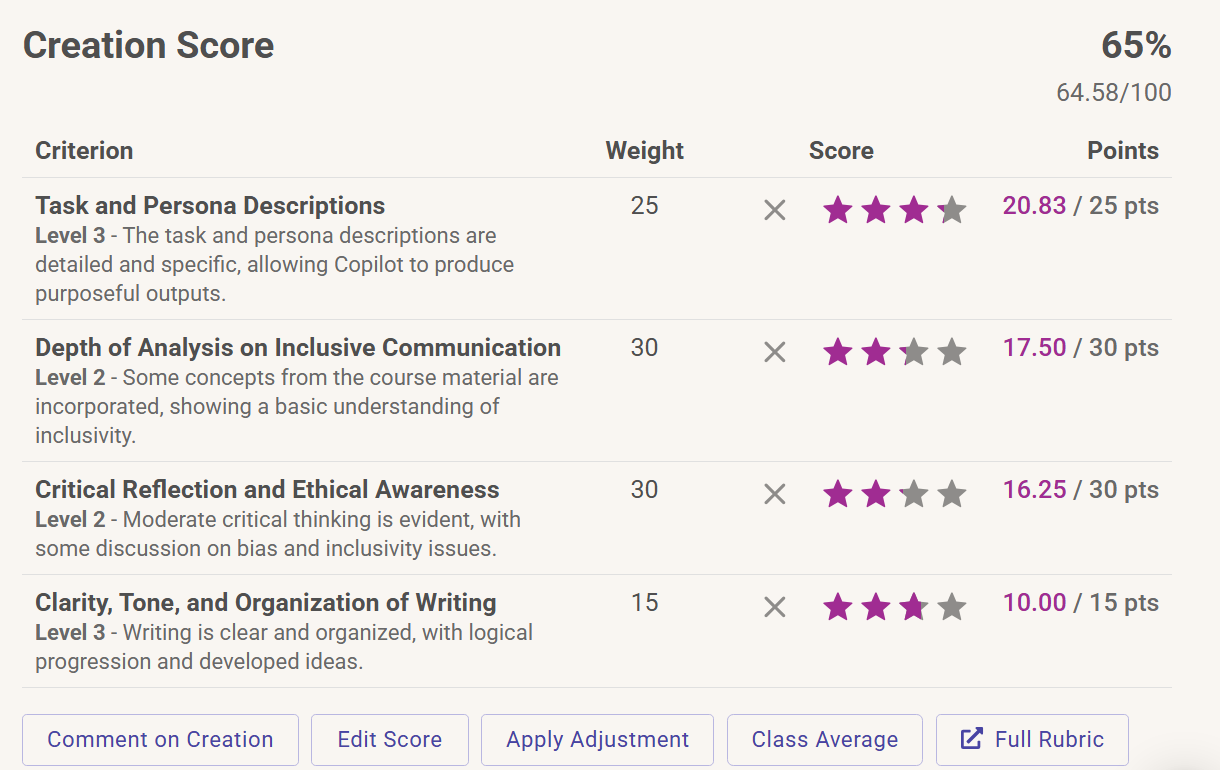
That final “feedback-on-feedback” step matters. It gives students agency, raises the bar on comment quality, and turns feedback into a teachable skill for teamwork and careers. In Robin’s asynchronous context, the double-blind, structured interaction also creates an inclusive space where every student’s voice is heard.
Read more: How to create a Compelling Asynchronous Learning Experience
What Students Gain
“Students are learning in a community-oriented environment, which is really a positive thing” - Prof. Robin Potter, Seneca Polytechnic
- Stronger critical thinking: By evaluating real peer work with criteria, students practice evaluative judgment, through weighing evidence, comparing alternatives, and justifying decisions. The rubric language guides them to analyze gaps and recommend revisions, supporting higher-order thinking skills.
- Metacognition and feedback literacy: The 360 loop requires students to reflect on both the product and the quality of feedback, making them better at giving and receiving critique. This fosters the development of lifelong skills in assessing and providing feedback to others, which are valuable beyond the classroom.
- Student engagement: Multiple perspectives and timely comments keep students involved throughout the assignment, not just at submission time. In large or online classes, that ongoing dialogue is a powerful driver of student engagement. Students develop a sense of community among themselves, enhancing their overall learning experience by being encouraged to interact, reflect, and share responsibility.
Teaching strategies that incorporate peer assessment prepare students for future collaborative and evaluative tasks, supporting the development of transferable skills essential for success in both academic and professional settings.
4 Reasons Why Kritik360 Works for Instructors
Kritik360 is designed for effective assessment at scale, balancing student-centered learning with instructor oversight:
- Anonymous, rubric-based evaluation: Criteria anchor comments in standards, improving accuracy and clarity for both graders and authors.
- 360-degree peer review: Students evaluate creations and then rate the usefulness of peer feedback, closing the loop to ensure quality and accountability.
- Time savings and grading fairness: Automated distribution, calibration mechanics, and visibility for instructors reduce the burden while protecting grading fairness and accuracy across sections and sizes.
- Fits any LMS and modality: From live presentations to papers, from STEM to social sciences, Kritik360 plugs into your LMS and supports diverse formats for authentic assessment—including large and asynchronous courses like Robin’s.
Impact You Can Feel: From Passive to Collaborative Learning
“Students are really motivated to perform — to do their own work.” - Prof. Robin Potter, Seneca Polytechnic
Robin describes a visible shift in her asynchronous courses. Students do not simply submit work and move on. They interrogate it by applying the rubric, citing course materials, and examining where AI supports or weakens communication for different audiences. Because each submission is reviewed by multiple peers, students encounter several distinct perspectives on the same task. This exposes blind spots, challenges assumptions, and encourages meaningful revision rather than surface edits.
For Robin, structured peer assessment also makes learning progress visible across the class. She can see how well students understand key concepts through the iterative feedback they give eachother, not just the final product. Students learn that critical thinking is not about criticizing others but about making justified judgments using criteria and evidence.
Over time, the classroom dynamic shifts. Students become less focused on earning a grade and more focused on improving their work, responding to feedback, and refining their reasoning. The result is a participatory learning environment where students take ownership of both their ideas and their development.
Want all the insights?
Access the full recording of our workshop with Prof. Robin Potter below:
Building Critical Thinking Skills through Process-based Peer Assessments
Build Critical Thinking Into Every Assignment with Kritik360 & Visible AI
Kritik360 helps you move beyond one-time submissions by engaging students in structured peer assessment, rubric-guided evaluation, and meaningful feedback. VisibleAI adds transparency to each student's working process, so you can guide ethical, responsible practices while gaining insight into how each student thinks and utilizes AI.
Together, they support deeper learning, stronger critical thinking, and greater confidence in the integrity of student work.
Try Kritik360 for free or book a discovery call to explore VisibleAI.